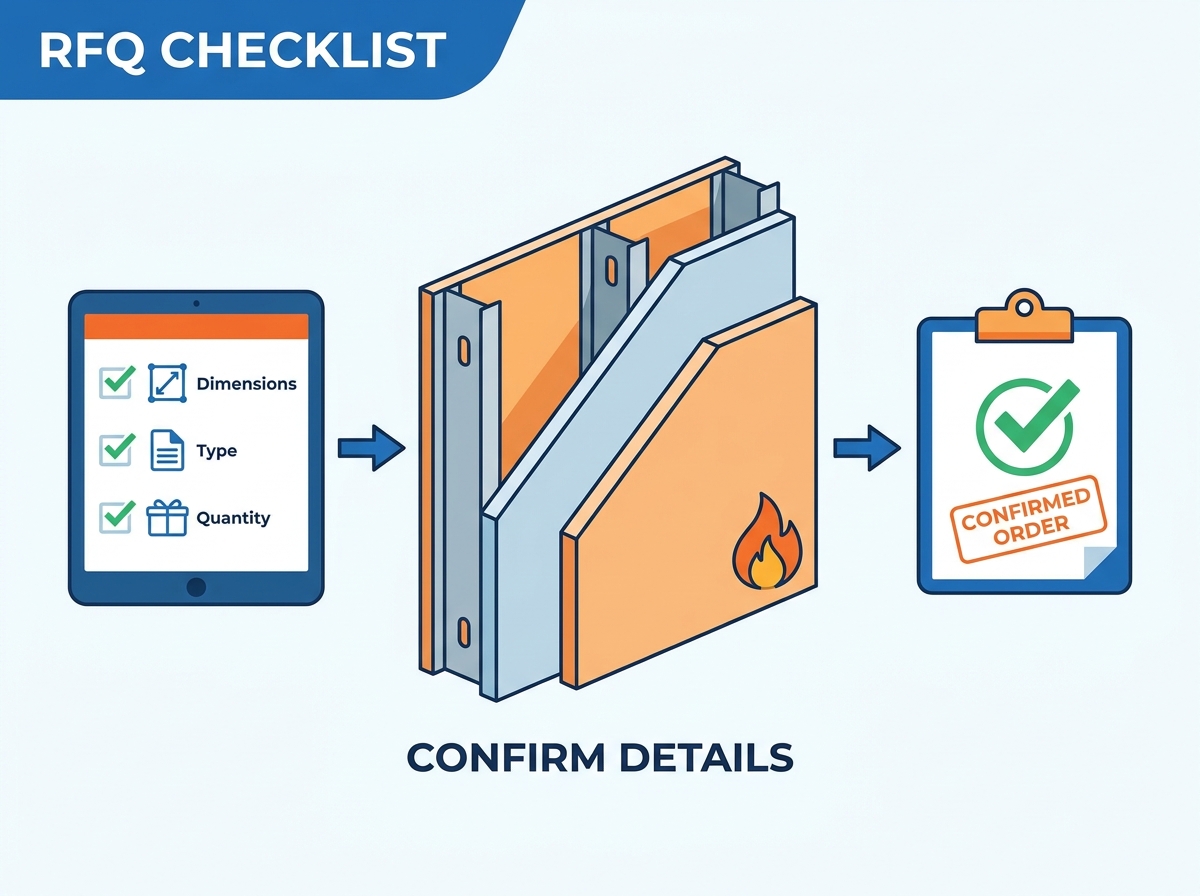
Ambiguous material specifications during the procurement phase drive compliance failures and project delays in commercial and large-scale residential construction. Submitting a generic Request for Quotation (RFQ) for bulk materials creates immediate risks. Suppliers often quote mismatched grades. They might ignore site-specific delivery constraints. Sometimes, they substitute inferior products that fail building code inspections.
Standardizing the RFQ process requires a rigorous technical and administrative checklist. This approach ensures suppliers provide accurate, apples-to-apples proposals. This guide outlines the non-negotiable details you must verify before issuing a purchase order for your next project. You will learn how to structure administrative requirements, define exact performance metrics, and evaluate supplier capabilities. Implementing these steps guarantees structural integrity and aligns material deliveries with your construction schedule.
Establish Administrative Clarity: Define project intent, RFI procedures, and mandate a signed execution of offer to ensure legal and procedural alignment.
Specify Exact Performance Metrics: Clearly define thickness, edge profiles, and core types (e.g., Type X for fire ratings) to prevent non-compliant material substitutions.
Verify System Compatibility: Ensure the quoted materials are tested and approved for integration with your specific structural framing and finishing compounds.
Mandate Logistics Transparency: Require suppliers to detail lead times, freight costs, and site-handling procedures.
Demand Certification Proof: Protect project liability by requiring up-to-date manufacturer testing data and compliance certificates directly within the RFQ response.
Why the RFQ Stage Dictates Project Success
The gap between architectural specifications and procurement execution frequently leads to on-site change orders. Architects specify performance criteria in the project manual. Procurement teams translate these criteria into purchase orders. When this translation lacks technical depth, site teams receive inadequate materials. A successful RFQ eliminates this gap. It achieves predictable deliveries, guaranteed compliance, and aligned schedules.
Vague RFQ language introduces severe timeline risks. Receiving the wrong board type halts production. Installing standard core boards in wet zones instead of moisture-resistant variants leads to immediate inspection failures. Site teams must then tear down the non-compliant work. This rework consumes labor hours and delays subsequent trades. Clear RFQ documentation prevents these cascading failures by forcing suppliers to confirm exact specifications before manufacturing begins.
Consider the operational impact of poorly defined material requests. When a procurement officer simply asks for a bulk quantity of gypsum board without specifying the application, the supplier defaults to the most common inventory item. This default is rarely suitable for specialized commercial zones like elevator shafts, commercial kitchens, or high-traffic corridors.
RFQ Approach
Supplier Response
On-Site Consequence
Generic "Drywall" Request
Quotes standard 1/2-inch residential board.
Fails commercial fire code inspections; requires complete tear-out.
No Delivery Specs
Ships via 53-foot enclosed van.
Truck cannot navigate tight urban site; materials must be hand-carried.
Detailed Technical RFQ
Quotes exact Type X, 5/8-inch board with flatbed delivery.
Passes inspection; boom truck loads material directly to the correct floor.
Structuring the RFQ: Essential Administrative Components
Before detailing technical specifications, you must establish foundational administrative elements. These components make an RFQ professional and legally binding. They set the tone for supplier interactions and establish clear rules of engagement for the bidding process.
Company Bio and Statement of Intent
Provide context on your project scale and application types. Outline your company quality standards. This information attracts tier-one suppliers. It helps them understand the scope of your operations. Suppliers allocate their best resources when they understand the project magnitude. Detail the specific building types involved, whether high-rise commercial, healthcare, or residential multi-family. A supplier handling a 40-story high-rise needs different logistics capabilities than one supplying a sprawling single-story warehouse.
RFQ Schedule and Contact List
Clearly define all procurement deadlines. Establish strict cut-off dates for Requests for Information (RFIs). Set firm deadlines for proposal submissions and sample deliveries. Designate a single procurement contact. This prevents suppliers from bypassing the official process and contacting site superintendents directly. A structured schedule keeps the procurement phase on track and prevents last-minute specification changes.
Signed Execution of Offer
Mandate that suppliers return a signed cover sheet. This document must acknowledge all terms, conditions, and technical specifications. A signed execution prevents post-award disputes. It legally binds the supplier to the exact parameters outlined in your checklist. Reject any proposals lacking this signed acknowledgment. This simple administrative step filters out suppliers who bid without reading the technical requirements.
The 10-Point Gypsum Board RFQ Checklist
Detailing technical requirements protects your project from inferior material substitutions. Use this ten-point checklist to evaluate supplier capabilities and ensure material compliance across all phases of construction.
1. Exact Dimensional Tolerances and Thickness
Define the exact thickness required based on the specific application. False ceilings typically utilize 12.5mm (1/2-inch) boards to reduce dead load on the suspension grid. Vertical partitions in commercial spaces require 15mm (5/8-inch) boards for impact resistance and structural stability. Shaft walls often require 1-inch thick specialized panels. Specify the exact length and width requirements. Ordering custom lengths, such as 10-foot or 12-foot boards, minimizes butt joints on tall walls.
Ask suppliers to confirm their manufacturing tolerances. Dimensional stability dictates the quality of the final wall. Boards with inconsistent thickness create uneven joints during installation. Uneven joints require excessive joint compound to conceal. This increases finishing labor and extends drying times. Require suppliers to state their allowable variance in thickness and edge squareness.
Board Thickness
Primary Application
Structural Benefit
1/4 inch (6.4mm)
Curved walls, archways
High flexibility for tight radii.
1/2 inch (12.5mm)
Residential walls, false ceilings
Lighter weight reduces ceiling grid load.
5/8 inch (15mm)
Commercial partitions, fire-rated assemblies
Increased impact resistance and fire delay.
1 inch (25.4mm)
Elevator shafts, stairwells
Maximum fire protection and structural rigidity.
2. Core Type and Compliance
Differentiate clearly between standard, Type X, and Type C cores. Standard cores suit basic residential partitions without specific fire ratings. Commercial corridors and demising walls require specialized cores. When requesting fireproof gypsum board, mandate strict compliance documentation. Type X boards contain glass fibers that reinforce the core during a fire event, preventing the board from disintegrating when exposed to extreme heat. Type C boards offer even higher fire resistance due to increased glass fiber density and shrinkage-compensating additives.
Mandate that suppliers provide Underwriters Laboratories (UL) or equivalent regional fire-resistance testing documentation. The RFQ must require proof of these classifications. Site inspectors will check the end tapes of the delivered boards for these specific UL marks. Missing marks result in immediate rejection by the fire marshal, forcing a complete tear-down of the affected walls.
3. Moisture, Mold, and Environmental Resistance
Identify all building zones requiring specialized facing. Bathrooms, commercial kitchens, and basements represent high-humidity areas. These zones require boards with fiberglass mat facing instead of traditional paper facing. Fiberglass mats resist moisture penetration and deny mold spores a food source. Standard paper-faced boards absorb ambient moisture, leading to structural degradation and severe mold proliferation behind finished walls.
Assess the supplier compliance with ASTM standards. Require documentation for ASTM D3273, which tests for mold resistance. Request data on water absorption rates. The RFQ must clearly separate dry-zone board quantities from wet-zone board quantities. This prevents suppliers from applying a blended average that compromises wet-zone integrity. Specify exactly which floors or rooms require the moisture-resistant variants.
4. Compatibility with the Framing System
Detail the gauge, spacing, and profile of the framing system used on-site. Include specifications for both vertical studs and false ceiling suspension grids. Board weight directly impacts structural deflection limits. A heavy, high-density board requires a heavier gauge stud to prevent wall flexing under lateral loads. Standard commercial framing often utilizes 20-gauge or 25-gauge steel spaced at 16 inches or 24 inches on center.
Require the supplier to confirm structural compatibility. The specified board weight and fastener requirements must align with the planned drywall metal frame. Incompatible systems lead to sagging ceilings. They cause fastener pull-through on vertical walls. Ensure the supplier reviews your framing specifications and guarantees their board performs within those parameters, specifically meeting L/240 or L/360 deflection criteria.
5. Edge Profiles and Finishing Requirements
Specify the required edge designs based on your target finish level. Industry standards range from Level 1 (basic fire taping in hidden areas) to Level 5 (premium smooth finish for high-glare lighting). Different edge profiles serve different finishing needs and directly impact the labor hours required by the taping crew.
Tapered Edges: Standard for most applications, allowing joint tape and compound to sit flush with the board surface.
Square Edges: Used primarily for specific architectural reveals or where joints will remain exposed.
Beveled Edges: Often used in custom ceiling applications to create intentional V-groove patterns.
Round Edges: Utilized in specialized systems to reduce edge damage during transit and handling.
Evaluate how the edge profile impacts labor efficiency. Poorly milled tapered edges require extra mudding passes. This increases the volume of joint compound required. It also extends the sanding phase, generating excess dust and delaying the painting crews. Demand precise edge milling specifications in the RFQ response.
6. Acoustic Performance and STC Ratings
Projects requiring sound dampening need specific acoustic targets. Specify the required Sound Transmission Class (STC) rating for demising walls, conference rooms, and hotel partitions. Standard boards offer minimal acoustic isolation, allowing airborne noise to travel freely between rooms.
Request data on high-density or acoustically enhanced boards. These specialized boards often incorporate viscoelastic polymers between gypsum layers to decouple sound waves. Verify the testing conditions for the provided STC ratings. The supplier must prove their board achieves the target rating when installed on your specific stud spacing, insulation configuration, and resilient channel setup.
7. Integration into the Complete Assembly
Treat the board as a component of a larger assembly, not a standalone product. The board must interact seamlessly with joint tape, setting compounds, and fasteners. Mismatched components cause joint cracking, surface delamination, and fastener popping as the building settles.
Ask suppliers about comprehensive warranties. Determine if they offer guarantees that cover the entire gypsum board wall system. Purchasing the board, tape, mud, and fasteners as a bundled package often secures a system-level warranty. Compare this approach against piecemeal procurement. System-level warranties significantly reduce liability if a failure occurs post-installation, as you only deal with a single manufacturer for claims.
8. Manufacturer Certifications and Material Verification
Require an explicit declaration of the manufacturer brand and the specific origin facility. White-labeling obscures the true source of the material. Knowing the origin facility allows you to verify quality control standards and track the material back to its source if defects arise on site.
Request comprehensive certification documents. Demand ISO 9001 certificates for manufacturing quality. For green building projects, request sustainability credentials. These include Environmental Product Declarations (EPDs) and Health Product Declarations (HPDs). Verify the recycled content percentage. Mandate Volatile Organic Compound (VOC) emission reports, such as Greenguard Gold certification, to ensure indoor air quality compliance.
9. Delivery Logistics, Handling, and Site Storage
Detail your site access limitations within the RFQ. Specify hoisting equipment availability and loading dock dimensions. Outline your climate-controlled storage conditions. Gypsum products degrade rapidly when exposed to rain or excessive humidity during transit and storage. A wet board loses its structural integrity and becomes a breeding ground for mold.
Require suppliers to outline their freight methods. Specify flatbed trailers with secure tarping or enclosed dry vans. Detail packaging requirements, including heavy-duty edge protection and proper palletization with adequate dunnage. Establish clear policies for replacing materials damaged in transit. The supplier must outline exactly how they handle returns for boards with crushed edges or moisture damage prior to installation.
10. Volume Forecasts and Lead Times
Provide the supplier with a clear project schedule. Include phased delivery dates and accurate volume forecasts. Bulk material orders rarely arrive in a single shipment. Phased deliveries keep site storage manageable and prevent material degradation caused by long-term exposure to site conditions.
Evaluate the RFQ response for realistic lead times. Specialized boards, such as high-impact or lead-lined acoustic variants, require longer manufacturing cycles. Ask suppliers to state their Minimum Order Quantities (MOQs) for custom lengths. Confirm their ability to meet your phased delivery schedule without causing site delays or requiring you to store excess material off-site.
Evaluating Supplier Proposals: Trade-offs and Overall Value
Analyzing RFQ responses requires looking beyond initial material metrics. A comprehensive evaluation weighs logistics, reliability, and system integration. You must assess the overall value each supplier brings to the project execution.
Material Metrics vs. Long-Term Reliability
Initial estimates often look favorable until you factor in logistics and yield. High freight logistics quickly negate favorable unit metrics. Poor manufacturing quality leads to high breakage rates on site. This poor yield means you must order more material to complete the same square footage. Delayed deliveries cause labor stand-by, wasting valuable site hours. Evaluate suppliers based on their proven delivery reliability and the structural integrity of their boards, rather than just the base material metrics.
Single-Sourcing vs. Multi-Sourcing
Consider the trade-offs of your sourcing strategy. Buying all system components from one manufacturer simplifies logistics. It ensures chemical and structural compatibility. It also provides a stronger system-level warranty. Sourcing boards from one supplier and framing from another introduces integration risk. If a wall fails, the board manufacturer might blame the framing deflection, while the framing manufacturer blames the board density. Single-sourcing eliminates this finger-pointing.
Scalability and Capacity
Assess the supplier capacity to handle sudden volume increases. Construction schedules frequently accelerate. You may need to expedite orders to meet a compressed timeline. Ask suppliers to prove their manufacturing capacity. Verify they hold sufficient inventory reserves to absorb schedule accelerations without delaying your phased deliveries.
Implementation Risks and Procurement Pitfalls
Even with a rigorous RFQ, procurement teams face implementation risks. Navigating these pitfalls requires strict oversight and clear verification protocols.
Substitution Risks
Suppliers often propose "or equal" substitutions in their RFQ responses. These substitutions rarely meet the technical baseline. A supplier might substitute a standard core board for a high-density board, claiming similar performance. You must identify and reject these unauthorized substitutions. Mandate that any proposed alternative includes a side-by-side technical comparison. Require independent testing data proving the alternative meets or exceeds the original specification.
Supply Chain Volatility
Raw material shortages disrupt manufacturing schedules. Mitigate these risks by requiring suppliers to prove inventory reserves. Ask for transparency regarding their raw gypsum sourcing. Suppliers relying on single-source raw materials face higher disruption risks. Partner with manufacturers who maintain diversified supply chains and hold strategic inventory buffers.
Pre-Installation and Phased Inspections
Establish a strict protocol for site teams to verify delivered products. The delivered material must match the approved RFQ specifications exactly. Site teams must check the end stamps for UL marks and ASTM compliance codes. They must verify the actual thickness using calipers. They must inspect edge integrity for transit damage.
Conduct these inspections prior to fixing the board to the frame. Installing incorrect or damaged boards guarantees rework. Implement phased inspections during the hanging process to ensure fastener spacing and joint alignment meet the manufacturer requirements.
Conclusion
Update your standard RFQ template to include mandatory fields for core type, edge profile, and dimensional tolerances.
Require all bidding suppliers to submit physical samples and UL certification documents alongside their initial proposals.
Establish a pre-installation inspection checklist for site superintendents to verify board thickness and edge integrity upon delivery.
Mandate a signed execution of offer from the supplier before issuing any binding purchase orders.
FAQ
Q: What is the standard thickness for commercial applications?
A: The standard thickness for commercial vertical partitions is 15mm (5/8-inch). This provides necessary impact resistance and structural stability. False ceilings often utilize 12.5mm (1/2-inch) boards to reduce the dead load on the overhead suspension grid. Always verify the required thickness against the architectural plans.
Q: How do I verify if the material is truly fire-rated?
A: You must check the board for specific Type X or Type C designations. Verify the presence of Underwriters Laboratories (UL) classification marks printed on the board backing or end tapes. The supplier must also provide the corresponding UL testing certificates in their RFQ response.
Q: Can I use any framing system with these boards?
A: No. The board weight and density must align with the specific gauge and profile of your framing. Using heavy, high-density boards on lightweight studs causes excessive deflection, leading to cracked joints and potential structural failure. Always verify compatibility.
Q: Why is edge profile selection important?
A: The edge profile dictates the finishing process. Tapered edges allow joint tape and compound to sit flush, making them ideal for standard flat walls. Selecting the wrong edge profile increases the volume of joint compound needed and significantly extends finishing labor hours.
Q: What certifications should I request for green building projects?
A: Request Environmental Product Declarations (EPDs) and Health Product Declarations (HPDs). You should also demand Volatile Organic Compound (VOC) emission reports, such as Greenguard Gold certification. Verify the recycled content percentage to ensure compliance with LEED or similar sustainability standards.
Q: How should site teams store delivered materials?
A: Store all boards flat on properly spaced dunnage to prevent sagging. Keep them in a dry, climate-controlled environment. Protect the edges from impact and cover the stacks to prevent dust accumulation and moisture absorption prior to installation.
Guangzhou Panda Commercial Development Co.,Ltd. is a company based in Guangzhou, China. We have more than 20 years experience in the production and export of wall and ceiling system products.
Address: Unit 1310, 13/F, South Tower of Xijiao Xieli Business Centre,No. 159, Middle of Qiaozhong Road, Liwan District, Guangzhou City, Guangdong Province, China
Subscribe To Our Newsletter
Promotions, new products and sales. Directly to your inbox.