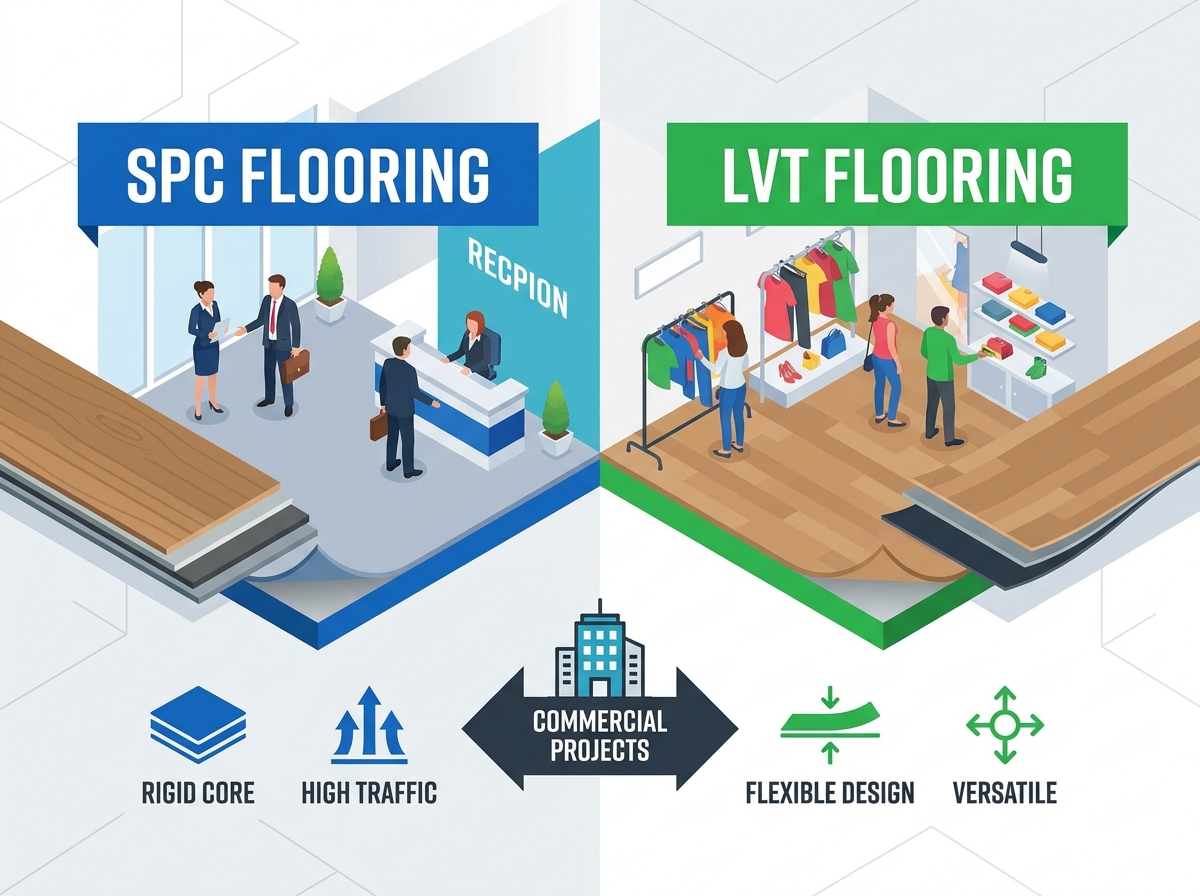
High-traffic commercial environments require flooring materials that can withstand rigorous daily use without compromising architectural aesthetics or requiring constant maintenance. Specifying the wrong material leads to premature wear, subfloor telegraphing, indentation from heavy fixtures, and disruptive replacement cycles. Facility managers and contractors constantly face the challenge of balancing durability with installation speed. Choosing between rigid and flexible vinyl formats dictates long-term performance. This guide breaks down the technical specifications, structural trade-offs, and implementation realities of SPC flooring and traditional LVT flooring to determine the optimal fit for specific commercial applications.
Core Composition: SPC (Stone Plastic Composite) utilizes a rigid limestone-based core for maximum dimensional stability, whereas traditional LVT (Luxury Vinyl Tile) relies on a flexible PVC core.
Terminology Clarity: While often compared to LVP (Luxury Vinyl Plank), LVT and LVP refer to the format (tile vs. plank), whereas SPC refers specifically to the advanced rigid core technology beneath the wear layer.
Load and Impact Tolerance: SPC flooring vastly outperforms LVT in resisting indentations from heavy commercial furniture, rolling loads, and high point-pressure.
Subfloor Forgiveness: The rigid nature of SPC bridges minor subfloor imperfections, making it ideal for rapid renovations, while flexible LVT requires near-perfect subfloor preparation to prevent telegraphing (visual transfer of bumps and dips).
Ergonomics and Acoustics: LVT offers superior underfoot comfort and natural sound dampening, making it preferable for environments where employees stand for long periods or where acoustic control is critical.
Understanding the Core Technologies
What is SPC Flooring?
Stone Plastic Composite represents a specific engineering approach to resilient flooring, commonly known in the field as rigid core. The manufacturing process abandons the traditional pressing methods used for older vinyl products. Instead, manufacturers extrude a mixture of natural limestone powder (calcium carbonate), polyvinyl chloride, and stabilizing agents. The limestone content typically makes up around 70% of the core, which fundamentally changes the physical properties of the plank.
The structural outcome is a highly dense, rigid board that completely resists the expansion and contraction cycles that plague standard vinyl products. Installers handle these planks much like laminate or engineered hardwood. The density, usually measuring between 1.9 and 2.0 g/cm³, gives the material a heavy, solid feel. This rigidity allows manufacturers to mill precise click-lock mechanisms into the edges. Installers can lock the planks together tightly without relying on adhesives. Furthermore, the dense core refuses to conform to the minor dips, dives, and trowel marks of an uneven concrete slab, providing a smooth finished surface even over imperfect subfloors.
What is Traditional LVT Flooring?
Luxury Vinyl Tile in its traditional format relies on a flexible, multi-layered construction. Manufacturers produce this material through a calendering process, fusing multiple layers of flexible PVC together under extreme heat and pressure. Many commercial-grade variations include a fiberglass scrim layer embedded within the PVC to provide dimensional stability and prevent the tiles from stretching or shrinking excessively.
The structural outcome is a pliable, softer material that conforms directly to the surface beneath it. Installers primarily secure traditional flexible tiles using a full-spread commercial adhesive, though some flexible click-lock variations exist. This flexibility makes the material incredibly easy to score, snap, and manipulate around complex architectural features, curved walls, and floor transitions.
You must understand the terminology overlap between LVT and LVP. Both utilize the exact same flexible PVC core technology. They differ only in their physical shape and printed decor. LVT mimics square or rectangular stone and ceramic tiles. LVP mimics long wood planks. When evaluating flexible vinyl against rigid core options, the foundational chemistry of the flexible PVC remains identical regardless of whether it comes in a tile or plank format.
Success Criteria for a Commercial Floor System
Selecting the right commercial floor system requires framing your evaluation around specific operational demands. A material that performs flawlessly in a corporate boardroom will likely fail completely in a high-traffic grocery store aisle. You must assess the environment before specifying the product.
Traffic Volume & Load: You must evaluate both foot traffic density and mechanical loads. Retail shelving units create massive static point loads that press constantly into the floor. Hospital beds, medication carts, and warehouse pallet jacks create punishing rolling loads. The flooring core must resist crushing and delaminating under these specific forces.
Environmental Variables: Temperature fluctuations and direct sunlight exposure dictate material selection. Large glass storefronts create localized heat zones that bake the floor daily. Unconditioned warehouses or three-season spaces experience extreme temperature swings. Moisture levels in the concrete slab also determine which installation methods will survive long-term.
Occupant Experience: Multi-story commercial buildings heavily regulate acoustic limits. You must evaluate Impact Insulation Class (IIC) and Sound Transmission Class (STC) ratings to ensure compliance with building codes. Ergonomic requirements also play a major role. Staff standing behind a pharmacy counter or hotel registration desk for ten hours need underfoot comfort to prevent joint fatigue.
Downtime Constraints: Renovation speed often dictates project viability. Retail spaces and healthcare facilities cannot afford prolonged closures. You must evaluate the speed of installation, including the time required for subfloor preparation and the curing times required for adhesives before the space can handle foot traffic again.
Head-to-Head Evaluation: SPC vs. LVT in Commercial Settings
Durability and Indentation Resistance
Commercial environments subject floors to extreme point loads. Heavy fixtures, display racks, and specialized equipment exert massive pressure on very small surface areas. SPC features a high-density limestone core that provides exceptional resistance to denting. It supports heavy commercial fixtures without compressing. When subjected to standard residual indentation tests, rigid core planks show almost zero surface deformation.
Conversely, traditional flexible LVT remains highly susceptible to permanent indentation under sustained heavy loads. The flexible PVC core naturally compresses under weight. Over time, heavy desks, retail gondolas, or filing cabinets will leave permanent divots in the floor. For retail environments, grocery stores, and warehouse-adjacent spaces, rigid core planks win decisively. The structural integrity of the limestone composite prevents surface crushing.
Subfloor Preparation and Tolerance
Subfloor preparation dictates the project timeline and labor allocation. Concrete slabs are rarely perfectly flat. Flexible LVT telegraphs every crack, divot, and trowel mark directly to the surface. The pliable material sinks into depressions and stretches over high spots. Installing flexible vinyl requires extensive use of self-leveling compounds, grinding, and patching. The labor hours associated with subfloor leveling for glue-down vinyl are substantial.
Rigid core technology changes this dynamic entirely. The rigid plank bridges minor imperfections in the subfloor. It spans small cracks and dips without telegraphing them to the surface. This capability saves days of prep work. It eliminates the need for extensive self-leveling in many renovation scenarios. This subfloor forgiveness makes rigid core planks a dominant choice in commercial renovation channels where speed is the primary objective.
Ergonomics and Acoustic Performance
Occupant comfort remains a major factor in commercial design. You must evaluate the physical toll on employees. LVT provides significantly more give underfoot. The flexible PVC absorbs impact, reducing fatigue for staff who stand for extended periods.
Sound transmission serves as another critical metric. SPC is naturally louder and more reflective. The dense stone core creates a distinct clicking sound under hard-soled shoes. Meeting commercial building codes for acoustics often requires specifying specialized acoustic underlayments when using rigid planks. Flexible vinyl absorbs sound naturally, reducing ambient noise in busy corridors. For hospitality venues, healthcare corridors, and open-plan offices, flexible LVT wins due to superior acoustics and ergonomic comfort.
Climate Stability and Moisture Resistance
Both systems are topically completely waterproof. Spills, routine cleaning, and wet-mopping will not damage the wear layer or the core. However, they perform very differently under temperature shifts. Spaces with large windows experience significant solar heat gain. Flexible PVC expands when heated and contracts when cooled. This movement can cause flexible vinyl planks to peak at the seams or gap at the ends if not properly acclimated and glued with high-temperature adhesive.
SPC offers superior dimensional stability. The stone core prevents the expansion and contraction gaps that plague traditional vinyl. It remains stable under direct sunlight and in spaces lacking continuous HVAC control. This thermal stability makes it ideal for entryways, large expansive commercial spaces, and facilities that shut down climate control over the weekend.
Performance Metric
SPC Flooring (Rigid Core)
Traditional LVT (Flexible)
Indentation Resistance
Excellent (High density limestone core)
Moderate (Susceptible to heavy static loads)
Subfloor Forgiveness
High (Bridges minor cracks and dips)
Low (Telegraphs imperfections, requires leveling)
Acoustic Dampening
Low (Requires attached or separate underlayment)
High (Naturally absorbs ambient noise)
Thermal Stability
Excellent (Resists expansion/contraction)
Moderate (Can gap or peak under extreme heat)
Ergonomic Comfort
Firm (Less give underfoot)
Cushioned (Reduces standing fatigue)
Installation Speed
Fast (Click-lock floating system)
Slower (Requires adhesive and extensive prep)
Rolling Load Tolerance
High (Resists delamination)
Moderate (Adhesive can fail under heavy rolling)
Financial and Operational Trade-Offs
Material and Installation Costs
Evaluating the financial impact requires looking beyond the initial material acquisition. Upfront material costs for rigid core products generally run slightly higher per square foot than basic flexible vinyl, though they align closely with premium commercial-grade LVT. Market positioning reflects these installation realities. Flexible vinyl remains highly popular for large-scale new builds. In new construction, contractors pour concrete slabs fresh and flat, minimizing the prep work required for glue-down applications.
Rigid core planks are heavily favored for renovations. The ability to float the floor over existing hard surfaces lowers demolition costs significantly. Compare the installation methods carefully. Click-lock floating floors require no adhesives. Glue-down vinyl requires commercial-grade adhesives, which add significantly to the material budget. The labor required to trowel adhesive, monitor open times, and roll the floor with a 100-pound roller also increases installation time.
Long-Term Maintenance and Lifecycle
The lifecycle of resilient flooring depends heavily on the surface protection. The wear layer dictates surface scratch resistance for both products, not the core. This clear urethane layer is measured in mils. A 20-mil or 28-mil wear layer provides commercial-grade protection. Both rigid and flexible options offer identical decor films and wear layer thicknesses. Scuffing and scratching will occur at the exact same rate if the wear layers are identical. Facility managers maintain both floors using neutral pH cleaners and standard auto-scrubbers.
Maintenance logistics diverge sharply when physical damage occurs. Replacing a damaged plank in a floating system requires unclicking the floor from the nearest wall all the way to the damaged area. This process disrupts operations in a large commercial space. Conversely, a glue-down flexible tile can be heated with a heat gun, scraped up, and replaced individually in minutes. This targeted replacement capability makes glue-down vinyl highly attractive for facilities management teams handling high-traffic zones.
Implementation Risks and Mitigation Strategies
Managing Subfloor Moisture and Alkalinity
Concrete slabs hold moisture. High moisture vapor emission rates (MVER) pose a severe risk to any flooring installation. For glue-down vinyl, excessive moisture causes alkaline salts to rise to the surface. This chemical reaction attacks the adhesive, causing it to re-emulsify and fail. The tiles will eventually lift, shift, and bubble. For floating rigid planks, moisture trapped beneath the waterproof core creates a dark, damp breeding ground for mold and mildew.
Mitigation requires strict adherence to testing protocols. Mandate proper relative humidity (RH) testing using in-situ probes (ASTM F2170) before installation. If RH levels exceed the adhesive manufacturer's limits, you must specify commercial moisture barriers or two-part epoxy mitigation systems. For floating floors, always install a 6-mil polyethylene vapor barrier over concrete slabs to block moisture migration.
Acoustic Mitigation in Multi-Level Commercial Spaces
Multi-story buildings enforce strict sound transmission codes to prevent noise complaints between floors. Failing to meet STC and IIC ratings can result in failed inspections and costly tear-outs. Rigid planks transmit impact noise directly to the structure below. Hard-soled shoes create a hollow tapping sound that travels easily through unmitigated concrete assemblies.
Mitigation requires proactive specification during the design phase. Specify rigid core products with pre-attached high-density acoustic backing. Materials like IXPE foam or cork dampen impact noise effectively. If the product lacks an attached pad, mandate a commercial-grade sound-dampening underlayment. Verify that the combined assembly of the slab, underlayment, and flooring meets the required acoustic codes before ordering materials.
Environmental Compliance and Indoor Air Quality
Indoor air quality remains a major concern in commercial construction. The primary risk with glue-down vinyl involves off-gassing from the adhesives used during installation. Additionally, older flexible vinyl formulations relied heavily on ortho-phthalates as plasticizers to achieve their flexibility, which raised environmental concerns.
Mitigation involves addressing material chemistry upfront. Rigid core planks benefit from consumer perception as a cleaner alternative. Because the core relies on limestone for rigidity, it does not require chemical plasticizers for flexibility. Regardless of the format chosen, demand strict environmental compliance. Look for FloorScore certification and GREENGUARD Gold ratings. Verify the manufacturer Safety Data Sheets (SDS) for both the flooring materials and any specified adhesives to ensure low VOC emissions.
Conclusion
Order physical samples of both materials to test against your specific site lighting, fixture colors, and expected rolling loads.
Consult with a structural engineer or flooring contractor to conduct ASTM F2170 moisture testing and evaluate current subfloor tolerances.
Verify commercial warranties based on the specified wear layer thickness, ensuring the mil count matches your expected daily traffic volume.
Calculate the total installation timeline, factoring in subfloor leveling, adhesive curing times, and immediate foot traffic requirements for floating systems.
FAQ
Q: What is the difference between LVP and SPC flooring?
A: LVP (Luxury Vinyl Plank) refers to the shape and style of the flooring, which traditionally uses a flexible PVC core. SPC (Stone Plastic Composite) is a specific, upgraded sub-category of vinyl flooring that features a rigid, limestone-infused core. Essentially, SPC is a more durable, rigid type of LVP.
Q: What is the difference in wear layers between SPC and LVT?
A: The wear layer is the clear top coating. Both SPC and LVT can have identical wear layers—typically 20-mil to 30-mil for commercial use. The difference lies in the core beneath it, not the surface scratch resistance.
Q: Is LVT flooring suitable for high-traffic commercial areas?
A: Yes, provided it has a commercial-grade wear layer (20+ mil) and is properly glued down. However, it may dent under heavy, stationary fixtures compared to rigid core options.
Q: Does SPC flooring require an underlayment?
A: Most premium commercial SPC flooring comes with a pre-attached underlayment (like IXPE foam). If it does not, a separate underlayment is highly recommended for acoustic dampening and minor subfloor smoothing.
Q: Can you install SPC flooring over existing tile?
A: Yes, SPC's rigid core allows it to be installed directly over existing hard surfaces like ceramic tile, provided the grout lines are not excessively wide or deep, which significantly reduces demolition costs during renovations.
Q: Which is more cost-effective for a commercial floor system: SPC or LVT?
A: Glue-down LVT often requires less initial material investment, making it popular for large projects, but it demands intensive subfloor prep and adhesive labor. SPC requires a higher material allocation but significantly reduces installation labor and prep time, balancing the overall resource requirements.
Q: Are SPC and LVT floor systems 100% waterproof?
A: Both materials are structurally waterproof and will not degrade from topical moisture. However, they do not act as a moisture barrier for the subfloor; flooding can still cause water to seep between seams and damage the subfloor beneath.
Guangzhou Panda Commercial Development Co.,Ltd. is a company based in Guangzhou, China. We have more than 20 years experience in the production and export of wall and ceiling system products.
Address: Unit 1310, 13/F, South Tower of Xijiao Xieli Business Centre,No. 159, Middle of Qiaozhong Road, Liwan District, Guangzhou City, Guangdong Province, China
Subscribe To Our Newsletter
Promotions, new products and sales. Directly to your inbox.